
Abstract
Reflexology is a non-invasive complementary therapy based on the principle that specific points on the feet, hands, and ears correspond to various organs and systems of the body. While often considered a modern wellness trend, reflexology has deep historical roots that trace back thousands of years to ancient civilizations. This paper presents a historical overview of reflexology, from its origins in ancient China and Egypt, through developments in Western medical paradigms, to its current scientific standing. By examining its cultural, theoretical, and clinical evolution, this review provides insight into how reflexology has transformed from a traditional healing art into a subject of scientific inquiry and integrative medicine.
1. Introduction
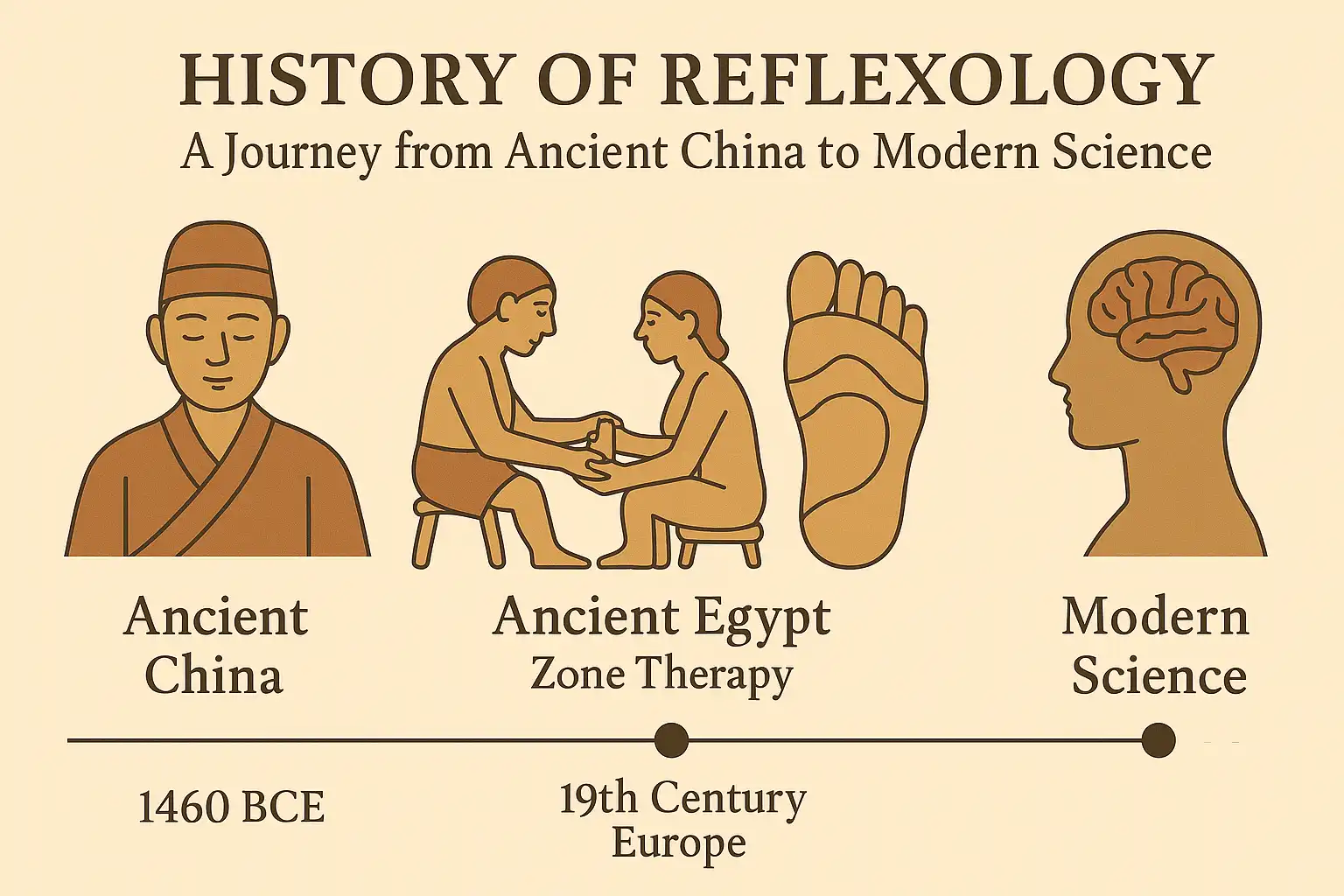
Reflexology, sometimes referred to as “zone therapy,” is a manual therapeutic technique that involves applying pressure to specific reflex areas of the feet, hands, or ears. Although the practice is often associated with modern complementary and alternative medicine (CAM), its historical foundation spans centuries and multiple cultural contexts. The development of reflexology reflects a broader evolution in medical thought—from energy-based healing systems to evidence-based complementary care. Understanding this history is essential for appreciating reflexology’s role in contemporary health care systems.
2. Ancient Origins of Reflexology
2.1 Ancient China
The earliest references to reflexology can be traced back to ancient Chinese medicine around 2500 BCE. Chinese practitioners believed that energy, or Qi, flows through pathways known as meridians in the body. Stimulation of certain points on the body, including the feet, was believed to unblock energy stagnation and restore balance. While this practice was more closely associated with acupuncture and acupressure, it laid the theoretical groundwork for reflexology.
2.2 Ancient Egypt
Significant historical evidence also comes from Egypt. A notable artifact, a wall painting found in the tomb of Ankhmahor (a physician of the 6th dynasty, circa 2330 BCE) in Saqqara, depicts individuals receiving foot and hand treatments. The inscription is often interpreted as stating, “Do not hurt me,” with the response, “I shall act so you praise me.” This suggests a therapeutic and possibly reflexological intent.
2.3 Indian and Ayurvedic Traditions
In ancient Indian medicine, foot therapy and massage were integral parts of healing practices. Ayurveda emphasized marma points—vital spots on the body, some of which correspond with reflex zones on the feet. The spiritual and physiological dimensions of foot care in India closely paralleled reflexology’s goals of restoring balance and promoting health.
3. Development in the West
3.1 19th Century Europe and Zone Therapy
The Western evolution of reflexology began in earnest in the 19th century. The concept of “zone therapy” was introduced by Dr. William Fitzgerald, an American ear, nose, and throat specialist. In 1917, Fitzgerald divided the body into ten longitudinal zones, each corresponding to specific areas on the feet and hands. He postulated that applying pressure within these zones could relieve pain and dysfunction in corresponding organs.
3.2 Eunice Ingham and the Modern Map
The modern practice of reflexology owes much to the work of Eunice Ingham, a physiotherapist who expanded on Fitzgerald’s zone theory. Ingham meticulously mapped the reflexes on the feet and hands, proposing that these reflexes mirrored the entire human body. Her books, including Stories the Feet Can Tell (1938), popularized reflexology as a therapeutic technique and led to its global spread.
4. Reflexology in Contemporary Health Care
4.1 Institutional Recognition
Over the past few decades, reflexology has gained greater acceptance as a form of complementary therapy. It is now practiced in hospitals, cancer centers, and hospices, often used to manage pain, anxiety, and stress. Organizations such as the Reflexology Association of America and the International Council of Reflexologists support standardized education and research.
4.2 Scientific Research and Evidence Base
Modern scientific interest in reflexology has led to numerous clinical studies examining its efficacy. While some studies report statistically significant reductions in anxiety, pain, and fatigue, the mechanisms remain unclear. Critics often cite methodological issues such as small sample sizes and placebo challenges. However, neuroscience-based hypotheses suggest reflexology may influence the autonomic nervous system and pain perception via central nervous system pathways.
5. Cultural and Philosophical Continuity
Reflexology’s journey from spiritual healing in ancient societies to measurable intervention in clinical settings illustrates a remarkable philosophical continuity. Whether framed through the lens of Qi, marma points, or neural zones, the core idea remains: the feet and hands can reflect and influence whole-body health. Reflexology’s cultural resilience may be attributed to its tactile, non-invasive nature and its capacity to blend with both traditional and modern paradigms.
6. Conclusion
Reflexology’s history is a testament to its enduring appeal and adaptive versatility. From ancient Chinese and Egyptian treatments to contemporary clinical applications, reflexology has persisted through millennia of medical change. While scientific validation continues to evolve, reflexology remains a globally practiced modality grounded in historical tradition and growing empirical interest. Future research will determine the full extent of its clinical value and help bridge the gap between ancient wisdom and modern science.
References
- Fitzgerald, W. H., & Bowers, E. (1917). Zone Therapy, or Relieving Pain at Home. Elizabeth Bowers.
- Ingham, E. (1938). Stories the Feet Can Tell. National Institute of Reflexology.
- Kunz, B., & Kunz, K. (2008). Reflexology: Health at Your Fingertips. Reflexology Research Project.
- Stephenson, N. L., Weinrich, S. P., & Tavakoli, A. S. (2000). The effects of foot reflexology on anxiety and pain in women with breast and lung cancer. Oncology Nursing Forum, 27(1), 67–72.
- McVicar, A. J., Greenwood, C. R., Fewell, F., et al. (2007). Evaluation of anxiety, salivary cortisol and melatonin secretion following reflexology treatment. Complementary Therapies in Clinical Practice, 13(3), 137–145.