
Abstract
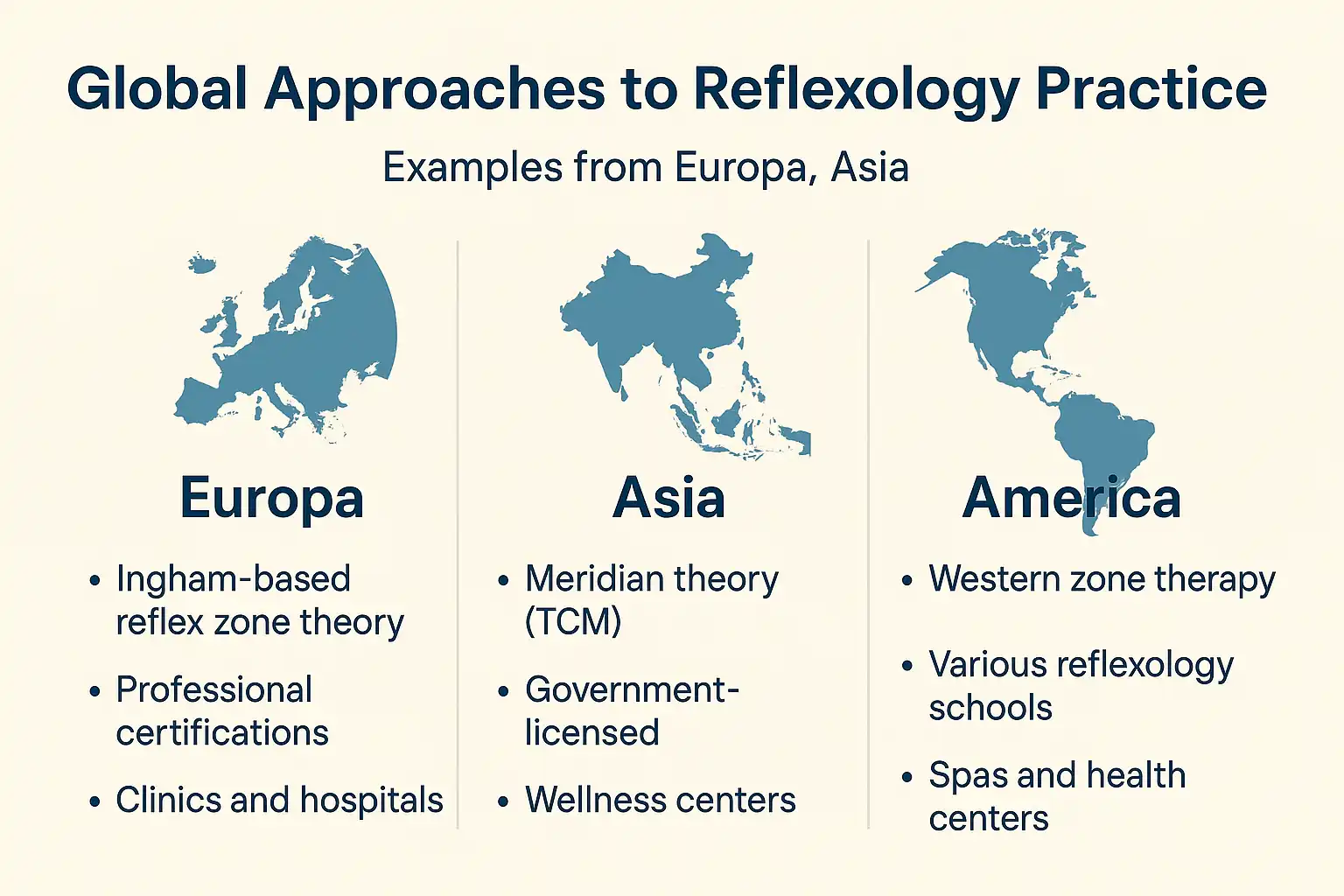
Reflexology, a non-invasive therapeutic technique involving the application of pressure to specific points on the feet, hands, or ears, is practiced globally with regional variations that reflect cultural, historical, and medical influences. This paper explores how reflexology is approached and implemented in different regions—specifically Europe, Asia, and the Americas—highlighting distinctions in theoretical foundations, training standards, and clinical integration. By comparing these regional practices, we aim to deepen the understanding of reflexology’s global diversity and the implications for cross-cultural health care and integrative medicine.
1. Introduction
Reflexology has gained worldwide attention as a complementary and alternative therapy used to promote relaxation, reduce pain, and support overall well-being. Although its principles are broadly similar—stimulating reflex zones to affect distant organs and systems—regional differences in training, philosophy, application, and regulatory frameworks reveal important cultural and clinical distinctions. This comparative analysis focuses on how reflexology is practiced in three major regions: Europe, Asia, and the Americas.
2. Reflexology in Europe
2.1 Historical Development
Reflexology gained traction in Europe in the early 20th century, primarily through the work of Eunice Ingham and later popularized by European practitioners in the UK, Germany, and Scandinavia.
2.2 Practice and Standards
- Theoretical Model: Ingham-based reflex zone theory
- Regulation: Varies by country; reflexology is often recognized as a complementary therapy
- Training: Professional certifications and diploma programs are widely available in the UK, Germany, and Nordic countries
- Clinical Integration: Commonly used in palliative care, maternity services, and stress reduction clinics
2.3 Notable Practices
- The UK Reflexology Association and Austrian Reflexology Institute provide professional accreditation and public education
- European reflexologists often emphasize holistic assessment, using tools like foot mapping and palpation
3. Reflexology in Asia
3.1 Historical Roots
Asia, particularly China, India, and Thailand, has a long-standing tradition of foot therapy rooted in ancient medical systems like Traditional Chinese Medicine (TCM) and Ayurveda.
3.2 Practice and Philosophy
- Theoretical Model: Meridian theory (China), marma points (India)
- Cultural Integration: Reflexology is deeply intertwined with traditional healing and everyday wellness practices
- Training: Often apprenticeship-based or integrated into TCM and massage curricula
- Regulation: Formalized in some countries (e.g., licensed under Thai Traditional Medicine)
3.3 Notable Practices
- Chinese foot reflexology involves vigorous pressure along meridians and is often practiced in public wellness centers
- Thai foot massage blends reflexology with energy line work (sen lines) and stretches
- Indian foot care may incorporate marma therapy and herbal oils, rooted in Ayurvedic principles
4. Reflexology in the Americas
4.1 Evolution and Influence
In North and South America, reflexology became popular in the mid-20th century, particularly in the United States and Brazil, often linked to holistic health movements.
4.2 Practice Characteristics
- Theoretical Model: Western zone therapy and anatomical reflex mapping
- Training: Provided through reflexology schools, holistic health institutes, and massage therapy programs
- Regulation: Reflexology is often unregulated or loosely governed under broader massage therapy laws
4.3 Clinical Applications
- Reflexology is widely used for stress, chronic pain, and support in cancer care settings
- In Latin America, it is also practiced informally within communities and blended with herbal medicine and spiritual healing
5. Comparative Analysis
| Region | Theoretical Base | Integration | Regulation | Practice Setting |
|---|---|---|---|---|
| Europe | Western zone theory | Complementary care | Semi-formal | Clinics, hospitals, private |
| Asia | TCM, Ayurveda, Thai traditional | Traditional system | Government-licensed | Wellness centers, spas |
| America | Western anatomical mapping | Holistic wellness | Informal to limited | Health centers, private, spas |
6. Global Challenges and Opportunities
6.1 Challenges
- Standardization: Inconsistent training and credentialing across countries
- Scientific validation: Varying levels of research support and skepticism in clinical settings
- Cultural misinterpretation: Difficulty translating culturally embedded practices across systems
6.2 Opportunities
- Cross-cultural education: Enhancing practitioner training through global exchange
- Integrative health systems: Reflexology can complement biomedical models in stress and pain management
- Research collaboration: Multi-country studies could increase scientific rigor and credibility
7. Conclusion
Reflexology has evolved as a global therapy shaped by cultural, historical, and medical paradigms. While Europe emphasizes standardization and integration into clinical care, Asia preserves traditional methods closely tied to energy medicine. In the Americas, reflexology exists primarily within holistic wellness frameworks. Recognizing and respecting these regional variations is crucial for the advancement of reflexology as a globally accepted therapeutic modality.
References
- Kunz, B., & Kunz, K. (2008). Reflexology: Health at Your Fingertips. Reflexology Research Project.
- Stephenson, N. L., Dalton, J. A., & Carlson, J. (2003). The effect of foot reflexology on pain in patients with metastatic cancer. Journal of Nursing Scholarship, 35(3), 287–292.
- Thai Ministry of Public Health. (2017). Thai Traditional Medicine Development Plan.
- UK Reflexology Association. (2020). Professional Standards and Education Guidelines.
- World Health Organization (2013). Benchmarks for Training in Traditional / Complementary and Alternative Medicine: Reflexology.