
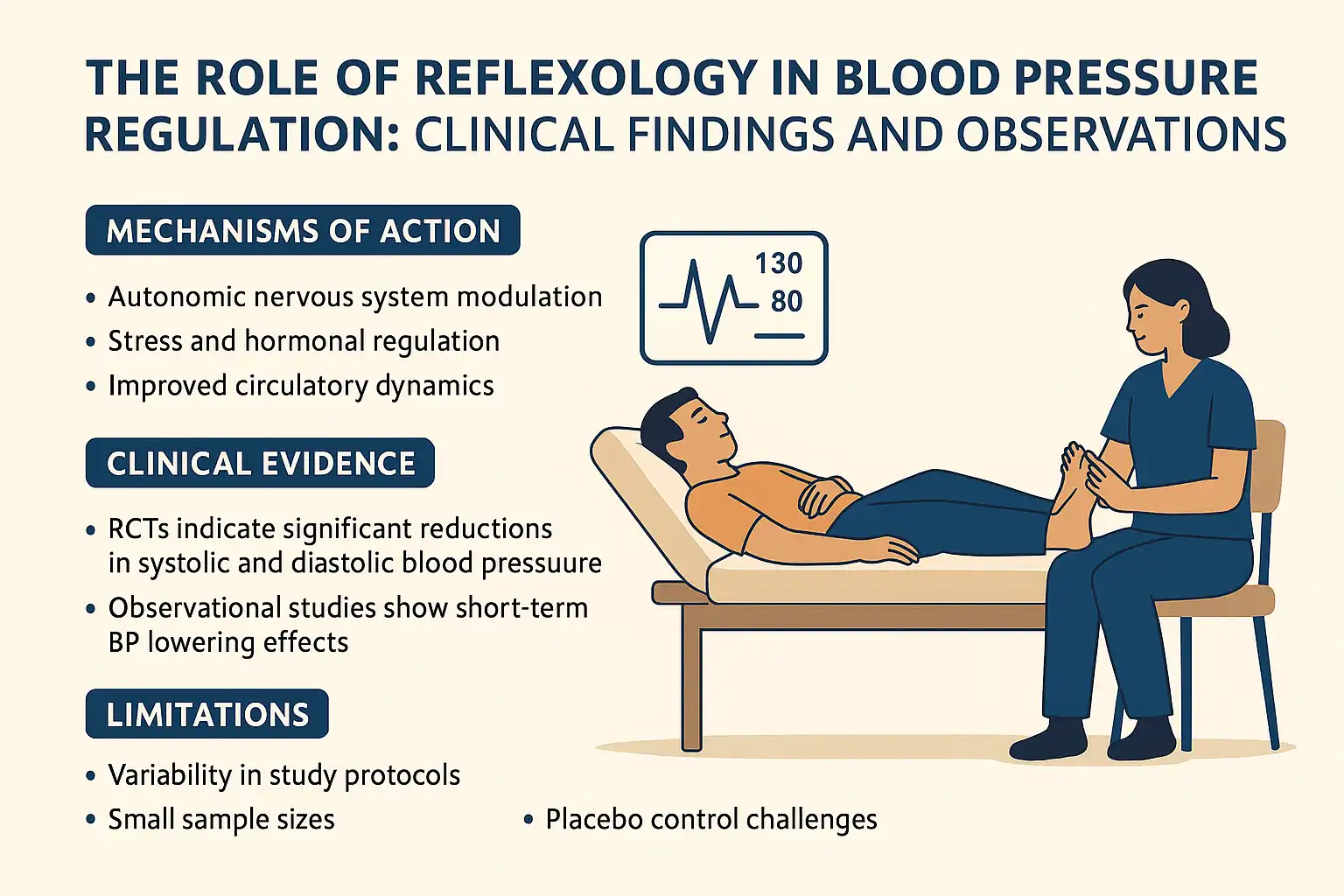
Abstract
Hypertension is a global public health concern and a major risk factor for cardiovascular disease. Non-pharmacological interventions such as reflexology are gaining interest as complementary therapies to support blood pressure management. This article examines clinical evidence and observational findings related to the role of reflexology in regulating blood pressure. While results vary across studies, consistent trends indicate reflexology’s potential to reduce both systolic and diastolic blood pressure through mechanisms involving stress reduction and autonomic nervous system modulation.
1. Introduction
Hypertension, often asymptomatic but potentially life-threatening, affects an estimated 1.28 billion adults worldwide. Despite the availability of effective medications, the importance of lifestyle and complementary interventions is increasingly recognized. Reflexology, which involves targeted pressure to specific points on the feet, hands, or ears believed to correspond to internal organs and systems, has been explored for its potential effects on cardiovascular function, particularly blood pressure regulation.
2. Mechanisms Linking Reflexology and Blood Pressure Control
2.1 Autonomic Nervous System Modulation
Reflexology is believed to stimulate the parasympathetic branch of the autonomic nervous system, promoting vasodilation and a reduction in cardiac workload. Increased parasympathetic tone may counteract sympathetic overactivity, a key contributor to hypertension.
2.2 Stress and Hormonal Regulation
Psychological stress is a known precipitant of elevated blood pressure. Reflexology has been shown to reduce perceived stress and cortisol levels, leading to improved vascular tone and lower blood pressure readings.
2.3 Improved Circulatory Dynamics
Manual stimulation of reflex zones may enhance peripheral circulation and promote systemic homeostasis, indirectly supporting vascular health.
3. Clinical Evidence and Observations
3.1 Randomized Controlled Trials (RCTs)
- McKeown and Fitzgerald (2002) conducted an RCT on 50 hypertensive patients. Participants receiving weekly reflexology sessions for 8 weeks showed significant reductions in both systolic and diastolic blood pressure compared to a control group.
- Yang et al. (2011) reported similar findings in a sample of 70 older adults with mild hypertension, where reflexology led to an average 8 mmHg reduction in systolic pressure.
3.2 Observational and Pilot Studies
- A pilot study by Lee and Kim (2015) examined 20 participants and reported short-term decreases in blood pressure and heart rate variability improvements after a single reflexology session.
- A case series conducted in a primary care setting found that regular reflexology (biweekly over 12 weeks) helped patients stabilize blood pressure levels when used alongside conventional treatment.
3.3 Meta-Analyses and Systematic Reviews
- A 2020 systematic review by Chen et al. included 11 studies and concluded that reflexology may lead to modest but statistically significant reductions in blood pressure, particularly when applied consistently over several weeks.
- However, variability in protocols and small sample sizes were cited as major limitations.
4. Limitations and Considerations
Although promising, the evidence base for reflexology in blood pressure regulation is limited by methodological weaknesses:
- Heterogeneity of intervention: Inconsistent reflex points, duration, and frequency of treatments across studies.
- Sample size and blinding: Many studies are underpowered or lack blinding, increasing the risk of bias.
- Placebo control: Designing an effective sham reflexology control remains a methodological challenge.
Moreover, reflexology should not be viewed as a replacement for antihypertensive medications, but as a potential adjunct to holistic care models.
5. Clinical Implications
Reflexology is a low-risk, non-invasive intervention that may offer supportive benefits for individuals with elevated blood pressure, especially in cases related to stress or anxiety. It may enhance patient engagement, promote relaxation, and contribute to overall cardiovascular well-being when integrated into multimodal care plans.
6. Conclusion
Reflexology demonstrates potential as a complementary strategy in blood pressure regulation, primarily through autonomic modulation and stress reduction. While current findings are encouraging, further rigorous, large-scale RCTs are necessary to establish standardized protocols and evaluate long-term effects. Until then, reflexology should be regarded as a supportive adjunct rather than a standalone therapy in hypertension management.
References
- Chen, X., Zhang, Y., Li, L., et al. (2020). Reflexology for the treatment of hypertension: A systematic review and meta-analysis. Complementary Therapies in Medicine, 51, 102430.
- Lee, H., & Kim, S. J. (2015). The effect of foot reflexology on blood pressure and heart rate variability: A pilot study. Korean Journal of Integrative Medicine, 23(1), 45–51.
- McKeown, M., & Fitzgerald, M. (2002). The effects of reflexology on blood pressure in patients with primary hypertension: A randomized controlled trial. Complementary Therapies in Clinical Practice, 8(1), 25–30.
- Yang, J. H., Park, K. H., & Ko, Y. H. (2011). Reflexology effects on blood pressure in elderly patients with mild hypertension. Journal of Geriatric Research, 18(2), 121–128.