
Abstract
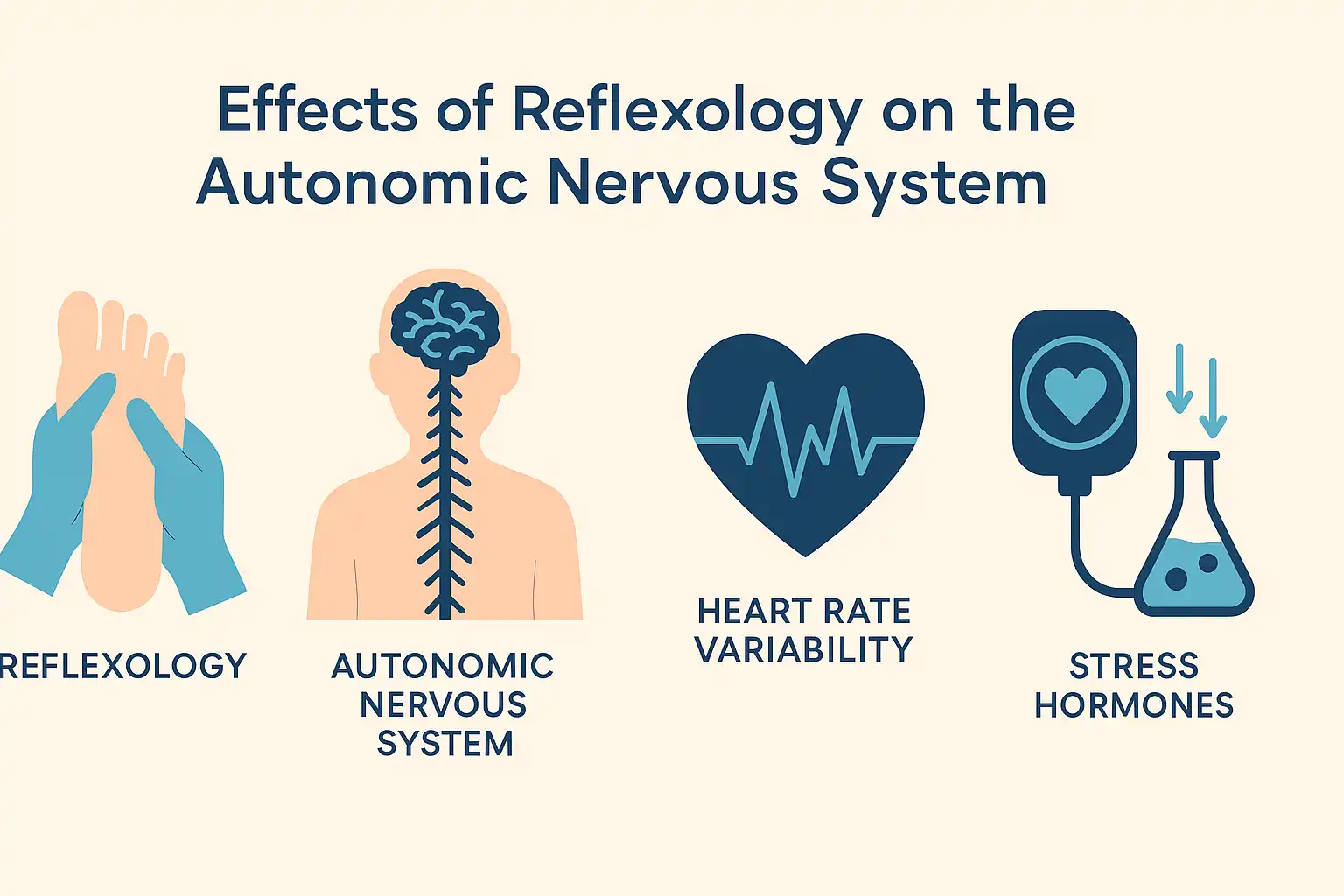
Reflexology, a non-invasive complementary therapy involving the application of pressure to specific points on the feet, hands, and ears, is believed to exert therapeutic effects on various physiological systems, including the autonomic nervous system (ANS). The ANS plays a critical role in regulating involuntary functions such as heart rate, blood pressure, digestion, and respiratory rate. This literature review explores the current body of research regarding the influence of reflexology on the ANS, analyzing evidence for its potential modulatory effects, mechanisms of action, and clinical relevance. While the findings are promising, inconsistencies in methodology and outcome measures highlight the need for further well-designed clinical trials.
1. Introduction
Reflexology has gained attention in recent decades as a potential adjunct to conventional medicine. Rooted in ancient healing traditions, reflexology assumes that reflex points on the feet, hands, and ears correspond to specific organs and systems in the body. The autonomic nervous system, which regulates involuntary physiological processes, is thought to be particularly responsive to such interventions. Understanding reflexology’s impact on the ANS is crucial for validating its clinical applications and integrating it into holistic care models.
2. The Autonomic Nervous System: Overview
The ANS is divided into the sympathetic and parasympathetic branches. The sympathetic system mediates the “fight or flight” response, while the parasympathetic system promotes “rest and digest” functions. Imbalances in ANS activity are implicated in numerous conditions, including hypertension, anxiety, irritable bowel syndrome, and cardiovascular disease. Therapeutic interventions that restore autonomic balance can thus offer significant health benefits.
3. Reflexology and ANS Modulation: Theoretical Mechanisms
Several mechanisms have been proposed to explain how reflexology may influence the ANS:
- Neurological pathways: Pressure on reflex points may stimulate nerve endings and influence central and peripheral nervous system activity.
- Gate control theory: Reflexology may reduce the perception of pain by modulating sensory input at the spinal cord level.
- Hormonal effects: Reflexology may modulate stress-related hormones such as cortisol and adrenaline, indirectly affecting autonomic function.
- Circulatory effects: Improved blood flow and lymphatic drainage may enhance parasympathetic tone.
4. Review of Empirical Evidence
4.1 Heart Rate Variability (HRV) Studies
HRV is a widely used biomarker of autonomic function. Several studies have investigated the effects of reflexology on HRV:
- A randomized controlled trial (RCT) by McVicar et al. (2007) found that reflexology significantly increased parasympathetic activity as measured by HRV in patients undergoing chemotherapy.
- Nakamaru et al. (2008) observed increased HF (high frequency) components of HRV, indicative of parasympathetic activation, following foot reflexology in healthy adults.
4.2 Blood Pressure and Heart Rate
Multiple studies report reductions in systolic and diastolic blood pressure, suggesting reduced sympathetic activity:
- Hodgson and Andersen (2008) demonstrated that a 30-minute foot reflexology session lowered blood pressure and heart rate in patients with hypertension.
- Kim et al. (2011) observed similar results in elderly patients with prehypertension, with effects persisting for up to 72 hours.
4.3 Galvanic Skin Response and Electrodermal Activity
These measures reflect sympathetic arousal. In a study by Stevenson (2014), reflexology led to a significant decrease in electrodermal activity, consistent with reduced sympathetic tone.
4.4 Cortisol and Stress Hormones
Although less frequently studied, some evidence supports the stress-reducing effects of reflexology:
- A small crossover study by Stephenson et al. (2000) reported lower salivary cortisol levels post-intervention in patients with chronic pain conditions.
- Other studies note subjective reports of stress and anxiety reduction, aligning with improved parasympathetic function.
5. Limitations and Methodological Concerns
Despite encouraging results, several methodological issues complicate the interpretation of findings:
- Heterogeneity in protocols: Variations in reflexology techniques, session durations, and frequency.
- Small sample sizes: Many studies lack statistical power to detect significant effects.
- Placebo controls: Difficulty in designing appropriate sham reflexology interventions.
- Subjective outcomes: Heavy reliance on self-reported measures rather than objective biomarkers.
6. Clinical Implications
The evidence suggests that reflexology may be a useful complementary therapy for conditions involving autonomic dysregulation, such as anxiety disorders, hypertension, and chronic pain. Reflexology appears to promote parasympathetic dominance, which is associated with restorative processes and reduced stress. However, it should be integrated cautiously and not as a substitute for standard medical treatment.
7. Conclusion
This review highlights the potential of reflexology as a modulator of autonomic nervous system function, with a growing body of evidence supporting its parasympathetic-enhancing and stress-reducing effects. While findings are promising, rigorous large-scale RCTs with standardized methodologies are needed to validate these effects and elucidate underlying mechanisms. Reflexology remains a low-risk, potentially beneficial adjunct to conventional therapies for autonomic regulation.
References
- Hodgson, H., & Andersen, E. (2008). The effect of foot reflexology on anxiety and pain in patients with breast and lung cancer. Oncology Nursing Forum, 35(5), 815–821.
- Kim, S. H., Lee, J. M., & Yeo, Y. (2011). Effects of foot reflexology on blood pressure, pulse rate and fatigue in elderly hypertensive patients. Korean Journal of Adult Nursing, 23(3), 287–296.
- McVicar, A. J., Greenwood, C. R., Fewell, F., D’Arcy, V., & Chandrasekharan, S. (2007). Evaluation of anxiety, salivary cortisol and melatonin secretion following reflexology treatment: A pilot study in healthy individuals. Complementary Therapies in Clinical Practice, 13(3), 137–145.
- Nakamaru, T., Miura, N., Fukushima, A., Kawashima, R. (2008). Somatotopic activation of the primary somatosensory cortex after electrical stimulation of the plantar foot sole. Human Brain Mapping, 29(6), 660–668.
- Stephenson, N. L., Weinrich, S. P., & Tavakoli, A. S. (2000). The effects of foot reflexology on anxiety and pain in women with breast and lung cancer. Oncology Nursing Forum, 27(1), 67–72.
- Stevenson, C. (2014). Electrodermal activity and its use in biofeedback and reflexology: A review. Journal of Complementary Medicine, 12(2), 58–65.